

The Power Glove: Mattel's Wearable NES Controller
A $100 NES peripheral that lasted one year and has been talked about for thirty-five.

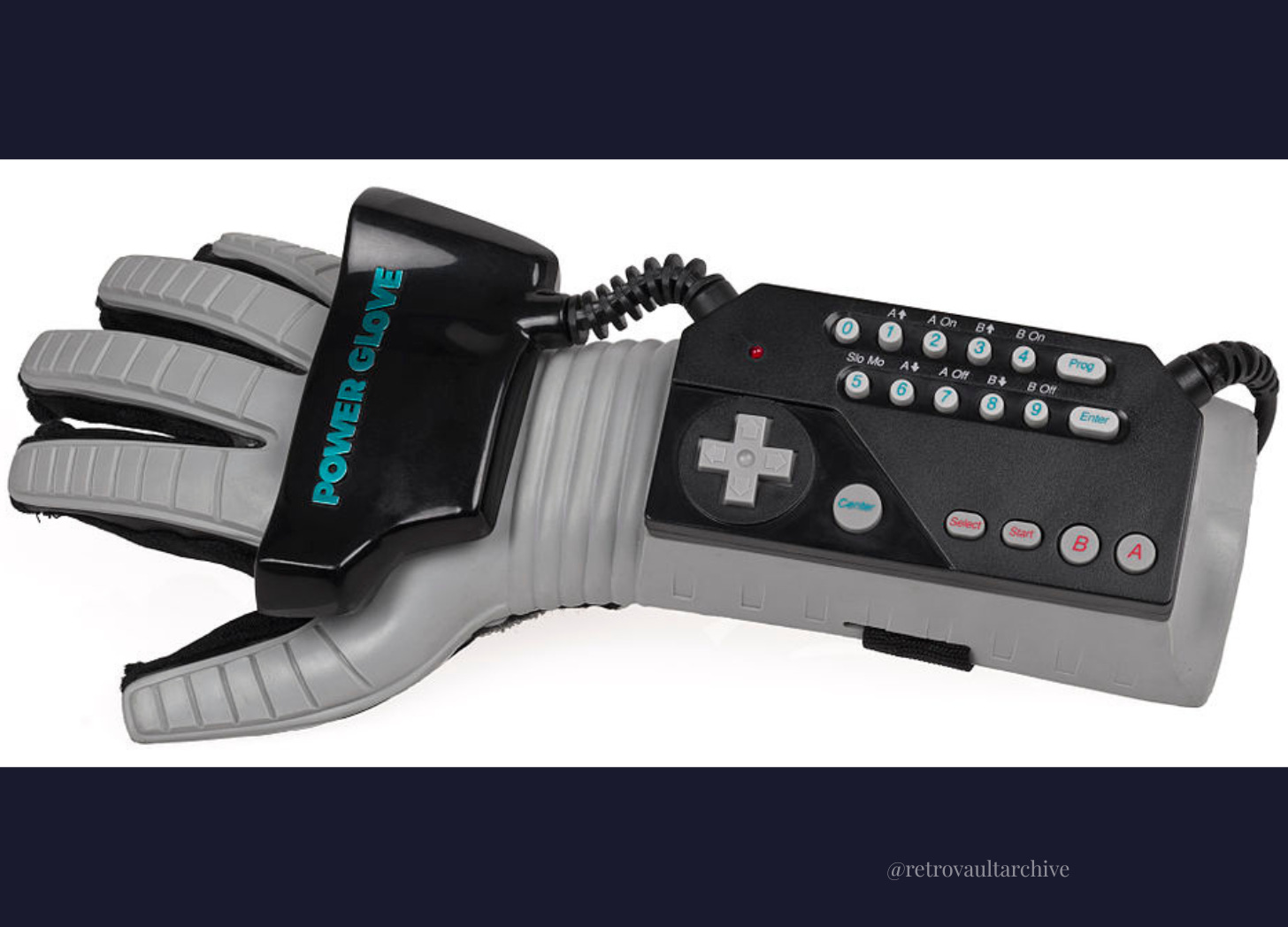
There’s a scene in The Wizard (Universal Pictures, 1989), where the villain opens a monogrammed metal briefcase, pulls out a gray and black glove, straps it onto his forearm, and announces: “I love the Power Glove. It’s so bad.”
In 1989 slang, “bad” really meant excellent. The kid meant it as a compliment. He had no idea he was actually writing the product’s obituary.
What it actually was
The Nintendo Power Glove launched in October 1989, manufactured by Mattel in the US and distributed in Japan by a company called PAX. Nintendo licensed the product and put its name on the box, but had nothing to do with designing or building it. That work fell to Abrams/Gentile Entertainment, who had eight weeks and a parts budget of under $26 per unit.
What they were trying to replicate, cheaply, was the VPL DataGlove: a motion-capture device that traced its origins to a 1976 MIT prototype by a researcher named Thomas Zimmerman. He had imagined the glove not as a game controller but as a musical instrument, a way to play air guitar by moving your fingers through the air. Zimmerman later partnered with VR pioneer Jaron Lanier, and versions of the DataGlove ended up being used by NASA for virtual environment simulation. The retail price on that original device was around $8,800, running on hardware that cost roughly $250,000.
Mattel wanted something on toy store shelves for $75 to $100.
The glove they got was gray and black molded hard plastic with a foam-padded interior, a numeric keypad running down the forearm, and carbon-ink flex sensors in four fingers. Two ultrasonic transmitters on the back of the hand sent pulses to a three-receiver sensor bar you mounted near your TV. The NES calculated your hand’s position in three dimensions by measuring how long those pulses took to arrive.
On paper, it was remarkable. The world’s first wearable game peripheral, tracking hand position in 3D space at a consumer price. It looked like something out of RoboCop, which was deliberate, the design team modeled the aesthetic on RoboCop’s gauntlet.
The part the box left out
Halfway through that eight-week development window, the engineering team discovered that the ultrasonic tracking system could only update 20 times per second. A standard NES controller updates 60 times per second. They were three times slower than a regular D-pad, the deadline was immovable, so they shipped it anyway.
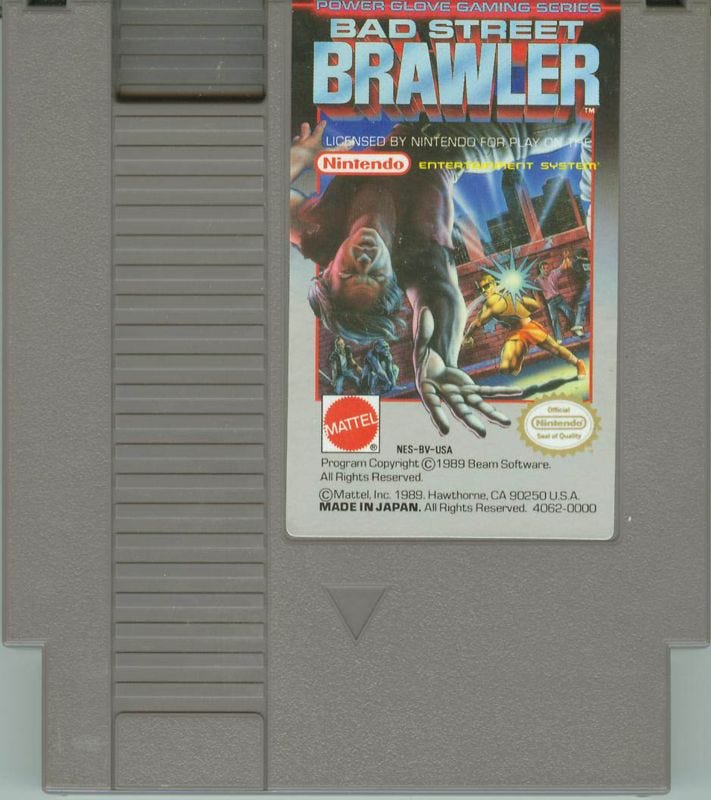
The result was a peripheral that required precise sensor placement to function at all, lost calibration constantly, and turned most games into a slow, imprecise, frustrating slog. Only two NES games were ever purpose-built for it: Super Glove Ball and Bad Street Brawler.
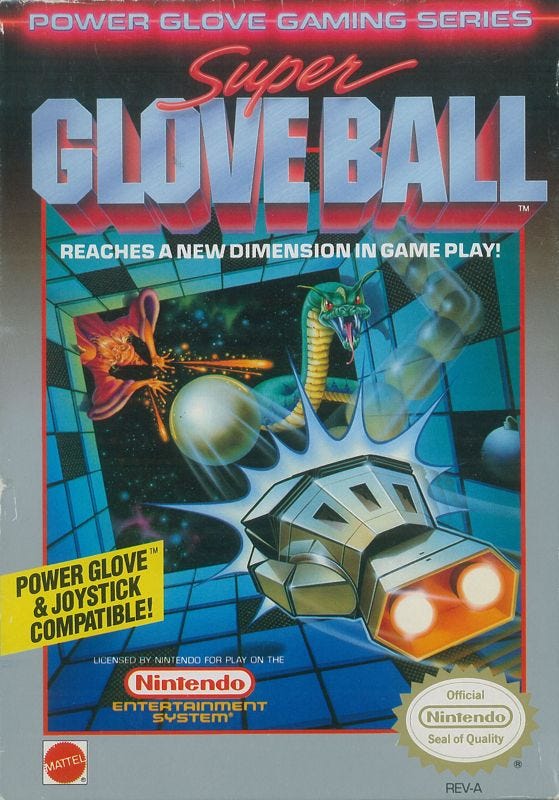
Both were also perfectly playable with a standard controller. Two planned exclusives, Glove Pilot and Manipulator Glove Adventure, were announced and never released. A third, Tech Town, made it as far as footage on an official promotional tape.
In Japan, PAX sold the glove purely as a novelty alternative controller. No Japanese games were ever developed for it.
What happened to it
Sales figures are genuinely contested. The Museum of Failure cites 600,000 units in the first six weeks, almost certainly driven by the movie releasing that December. A Nintendo fan wiki puts US sales closer to 100,000. Total gross revenue appears to have been around $88 million, which means the gloves left shelves. What happened after customers got them home is a different story. The Power Glove was discontinued in 1990, one year after it launched.
It didn’t disappear, though. Throughout the 1990s, early VR researchers bought Power Gloves by the case. The glove offered ultrasonic absolute positioning in a commercially available package at a price that was laughable compared to the DataGlove it was based on. University labs and hardware hackers used it as a cheap substitute, routing it through bridging software called REND386. The technology inside the toy outlasted the toy.
How it refused to stay dead
The culture around it lasted even longer. The Wizard scene has been quoted and memed for 35 years. The glove turned up in Freddy’s Dead: The Final Nightmare in 1991, in the YouTube short Kung Fury, in Andy Weir’s 2021 novel Project Hail Mary, and in the 2021 film 8-Bit Christmas. A feature documentary, The Power of Glove, was Kickstarted in 2013, premiered at the New Orleans Film Festival in 2017, and won Best Feature Film at the Southern-Fried Gaming Expo. The Museum of Failure includes it as a permanent exhibit, with the note that Nintendo learned from the experience and created the Wii fifteen years later.
One last thing worth knowing, Jaron Lanier, who helped develop the underlying DataGlove technology before it became a toy, went on to become one of the most prominent critics of social media’s effects on society; the author of You Are Not a Gadget and Ten Arguments for Deleting Your Social Media Accounts Right Now. The Power Glove is, in a small way, part of his origin story.
Collector notes
The Power Glove is not rare. It’s a nostalgia buy rather than a scarcity play, and the market reflects that. Loose (glove only, untested) runs roughly $100–$130. Complete in box with sensors and manual: $200–$295. Sealed new in box: around $725. Professionally graded: up to $2,940. Sales volume is thin, about one loose unit a month, four complete-in-box examples a year, per PriceCharting data.
A question
There’s something strange about an object that failed so completely at its stated purpose and became one of the most recognizable artifacts of an entire era of gaming. The glove barely worked. It was on the market for a year. It’s been referenced, quoted, and analyzed for 35 years since.
Do you think the Power Glove would be remembered at all if Lucas Barton hadn’t opened that briefcase? Or did The Wizard essentially invent the legend from scratch, independent of anything the hardware actually did?
Image:Evan-Amos, Public domain, via Wikimedia CommonsCommons