

The Gilbert U-238 Atomic Energy Lab, 1950
A.C. Gilbert put real uranium ore, a working Geiger counter, and a government prospecting manual into a toy suitcase and sold it for Christmas.

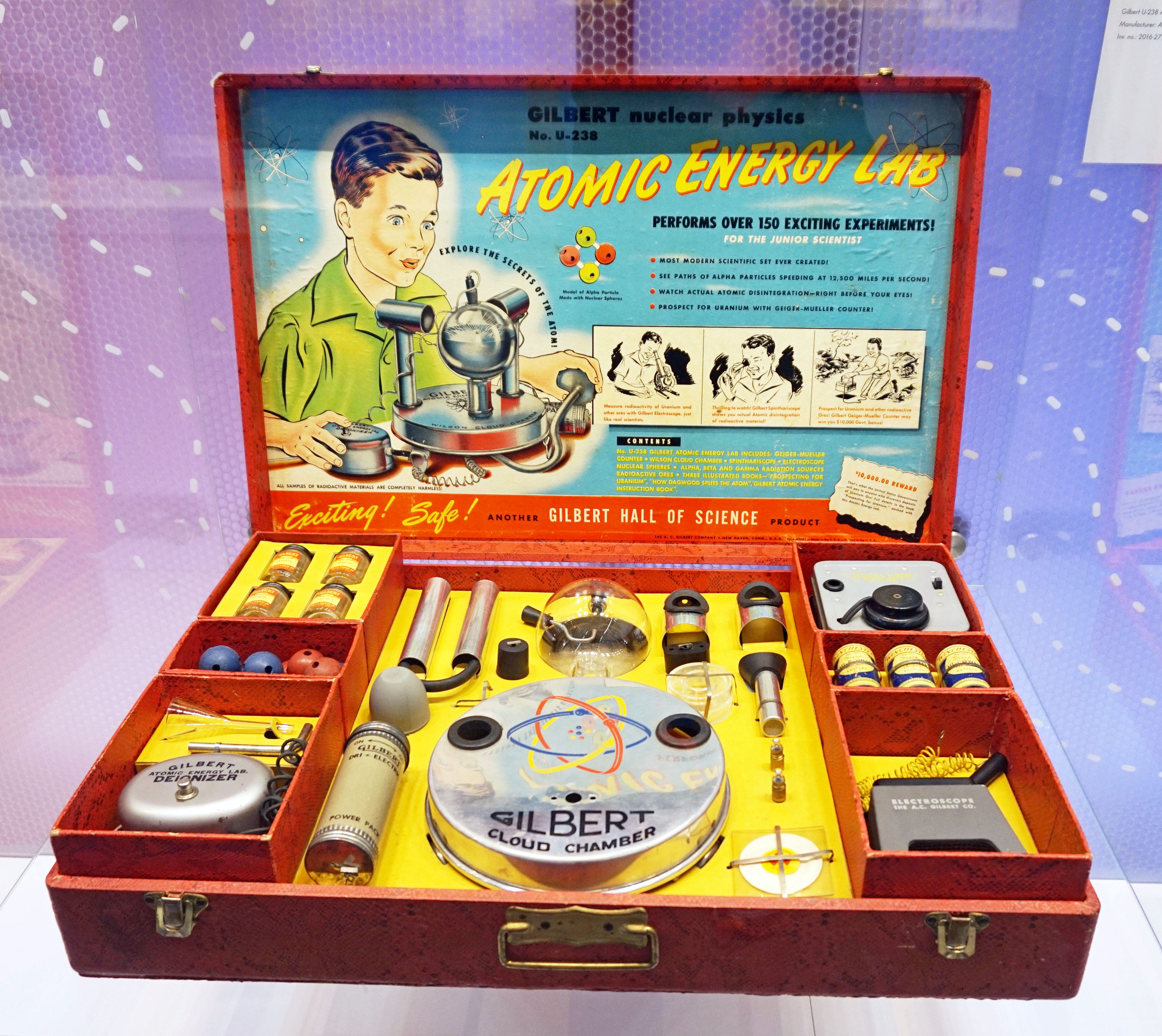
The idea of the Gilbert U-238 Atomic Energy Lab is almost unbelievable, until you see the photograph of it. Yes, it was a real product, made by A.C. Gilbert Company, New Haven, Connecticut, 1950, and sold in toy stores. Priced at $49.50, which in today’s money sits somewhere between $530 and $660 depending on which inflation calculator you use. A pretty hefty sum for a working family, spent on a box containing actual radioactive ore samples for your child.
I had never heard of this until I started researching it. Once you know it existed, it is hard to forget.
What it was
Alfred Carlton Gilbert founded the A.C. Gilbert Company in New Haven in 1909. Before that, among other things, he was an Olympic athlete who won the gold medal in the pole vault at the 1908 London Games, the world record holder in consecutive chin-ups. He pivoted into toys, invented the Erector Set, and by the 1940s was one of the most prominent toy manufacturers in the country. During World War I he successfully lobbied the U.S. government to allow toy production to continue, a feat that earned him the informal title “The Man Who Saved Christmas.”
The Atomic Energy Lab arrived in 1950, right at the height of the postwar atomic enthusiasm. The U.S. government had a public relations interest in normalizing atomic energy. They hoped building a scientifically literate generation would power America’s nuclear program. Gilbert’s catalog copy promised that all radioactive materials had been “certified as completely safe by Oak Ridge Laboratories, part of the Atomic Energy Commission.” The kit was not a fringe product operating in a regulatory gray area. It had the government’s active encouragement.
What was actually inside
Four glass jars of uranium-bearing ore: autunite, torbernite, uraninite, and carnotite, all sourced from the Colorado Plateau. A battery-powered Geiger-Müller counter that actually worked, not just a toy version, a functional radiation detector. A Wilson cloud chamber containing a polonium-210 wire source, which allowed you to watch alpha particles trace visible condensation trails through supersaturated air. A spinthariscope for viewing radioactive decay flashes on a fluorescent screen. An electroscope.
Also included was a 60-page instruction manual describing 150 experiments. A government-issued booklet called Prospecting for Uranium, jointly published by the U.S. Atomic Energy Commission and the U.S. Geological Survey, which explained how to identify uranium deposits in the wild, how to extract ore, and how to sell it to the government, which had an active uranium purchasing program at the time. And a comic book called Dagwood Splits the Atom.
The comic book was co-written by General Leslie Groves. The military director of the Manhattan Project. The man who oversaw the building of the atomic bomb wrote a preface for a children’s toy, which reads in part: “This book will reassure the fearful that the future can be made bright.” The comic features Dagwood, Blondie, Popeye, Flash Gordon, Mandrake the Magician, and Prince Valiant all attending an atomic physics lecture together.
What happened to it
The kit sold fewer than 5,000 units across 1950 and 1951. A.C. Gilbert attributed this mainly to the price, $49.50 was quite expensive for a toy at that time. Safety concerns were not widely discussed either and do not appear to be why production was ended. A 1953 company letter that survived with an auctioned example reads: “We regret exceedingly to advise you that we have discontinued manufacturing this Laboratory, it was very difficult to obtain some of the materials and also due to Government Restrictions.”
Discount stores cleared remaining stock through 1952 and 1953. The 1952 Gilbert catalog replaced it with a much more modest “No. 11 Gilbert Chemistry Atomic Energy Set” containing no radioactive materials at all. There was no recall, no legal action, no safety order, it just stopped being made. It was a quiet end for one product, but the company itself would not fare much better.
The A.C. Gilbert Company survived until 1967, when it filed for bankruptcy following Alfred Gilbert’s death in January 1961 and a failed hostile takeover attempt. The Erector Set name was acquired by Gabriel Industries for a nominal $0.00, with a royalty agreement tied to future sales. No modern toy company has attempted anything comparable to the Atomic Energy Lab.
What Survived
The polonium is gone from every surviving set. The cloud chamber’s alpha source was polonium-210, with a half-life of 138 days. Within a year of manufacture, every single cloud chamber in every surviving kit had gone permanently inert.
The uranium ore jars are a different matter, however. Uranium-238 has a half-life of 4.5 billion years, which is why physicists and radiation safety specialists on record consistently note that the ore levels were low-activity. Alpha radiation cannot penetrate skin. The manual’s warning not to remove the ore from its jars was framed not as a health concern but as a way of “raising background radiation and invalidating your experimental results.” The real risk, to the extent there was one, was inhalation of ore dust, but no documented health incidents have ever been traced to the product.
Worth noting as a point of interest, Gilbert’s was not the first children’s atomic kit. Porter Chemical Company’s Chemcraft line included uranium ore specimens as early as 1947, predating the Atomic Energy Lab by three years (confirmed by the Oak Ridge Associated Universities Health Physics Museum). A hobbyist source additionally claims a separate kit included actual radium samples, but that detail hasn’t been verified by an institutional source.
Collector notes
With fewer than 5,000 made and over 70 years of attrition, surviving complete examples are genuinely rare. The market has moved significantly in recent years. A complete red-case example in very good condition sold at RR Auction in June 2025 for $14,196. A complete tan-case first edition, the rarer 1950 variant, sold at RR Auction in December 2024 for $16,500. Incomplete examples run $3,000 to $12,000 depending on what’s missing.
The most commonly missing components are the radioactive source vials, which were sometimes discarded by alarmed parents in later decades, and the polonium-210 cloud chamber wire, which as noted above is inert in every surviving set regardless. The tan-case first edition is considered the rarer find, but the red-case second edition is the one more commonly seen at auction.
The set is a permanent exhibit at the Museum of Failure. The traveling Museum of Failure’s display includes an original complete example, with its uranium ore jars intact. Because of this, it must be handled as a licensed radioactive materials exhibit under applicable regulations in each country it visits. It is currently held in public collections at the Oak Ridge Associated Universities Health Physics Museum, the National WWII Museum in New Orleans, and the Deutsches Museum in Munich.
For images: the Deutsches Museum example photographed by Tiia Monto is available on Wikimedia Commons in the public domain and shows the full open set clearly.
A question
The thing that stays with me about this one is the government’s role. This was not a rogue manufacturer slipping something past regulators. The Atomic Energy Commission certified it. The Geological Survey provided the prospecting manual. General Groves wrote the comic book preface. A large part of the postwar American government pointed at this toy and said, this is fine, this is good.
What I keep wondering is whether the people involved actually believed all of it, that a child with uranium ore jars and a Geiger counter was going to grow up and power America’s nuclear program, or whether the optimism was just performance.
Do you think there’s anything similar to this going on today, something being sold to children that a future generation will look back at the way we look back at this?
Image: Deutsches Museum, Munich / Tiia Monto, Public Domain, via Wikimedia Commons